Bethesda Presbyterian Church
Russellville, Tennessee
"Ghost hunting" teens vandalizing a historic church and cemetery in eastern Tennessee have been arrested. I covered this in my Southern Spirit Guide blog, here.
Showing posts with label Church Cemeteries. Show all posts
Showing posts with label Church Cemeteries. Show all posts
Saturday, August 13, 2011

Tuesday, August 9, 2011
Colonials, Confederates and Victorians--Churchyard of Prince George Winyah Episcopal Church
Prince George Winyah Episcopal Church
300 Broad Street
Georgetown, South Carolina
Just the name Prince George Winyah has a colonial feel to it: a mix of honoring royalty and an Indian name, Winyah, the original name of Georgetown. This parish is one of the oldest in South Carolina having been founded in 1721. The church itself dates to around 1750 and I presume the churchyard dates to the same period, though I can currently find nothing to support that. The churchyard is lovely and verdant. If you visit in the mid-summer, be sure to bring some type of insect repellent as the mosquitoes are positively vicious. I wanted to stay longer, but the mosquitoes wanted to feast on me.
Sources
McCorkle, Norman. National Register of Historic Places Nomination Form
for Prince George Winyah Episcopal Church. 14 February 1971.
Prince George Winyah Episcopal Church. Wikipedia, the Free Encyclopedia.
Accessed 9 August 2011.
300 Broad Street
Georgetown, South Carolina
Just the name Prince George Winyah has a colonial feel to it: a mix of honoring royalty and an Indian name, Winyah, the original name of Georgetown. This parish is one of the oldest in South Carolina having been founded in 1721. The church itself dates to around 1750 and I presume the churchyard dates to the same period, though I can currently find nothing to support that. The churchyard is lovely and verdant. If you visit in the mid-summer, be sure to bring some type of insect repellent as the mosquitoes are positively vicious. I wanted to stay longer, but the mosquitoes wanted to feast on me.
 |
| View of the cemetery. Photo 2011, by Lewis Powell IV, all rights reserved. |
 |
| Late 19th century plot. Photo 2011, by Lewis Powell IV, all rights reserved. |
 |
| Victorian marker for Joanna Ward Pyatt, d. 2 June 1882. Can anyone identify the flowers on the stone? Photo 2011, by Lewis Powell IV, all rights reserved. |
 |
| Neoclassical stone for Joseph Benjamin Pyatt, d. 28 July 1910. Photo 2011, by Lewis Powell IV, all rights reserved. |
 |
| Front of the Neoclassical marker for M. Lee Ward, d. 9 October 1885. Photo 2011, by Lewis Powell IV, all rights reserved. |
 |
| Back of the marker for M. Lee Ward, d. 9 October 1885. Photo 2011, by Lewis Powell IV, all rights reserved. |
 |
| An unusual Neoclassical stone for Florence, daughter of Richard Henry and Eliza Lee, d. 7 February 1883. Photo 2011, by Lewis Powell, IV, all rights reserved. |
 |
| Back of the stone for Florence Lee. Photo 2011, by Lewis Powell IV, all rights reserved. |
 |
| Unusually shaped stone for Charles Garnett Stone, d. 10 June 1869. Photo 2011, by Lewis Powell IV, all rights reserved. |
 |
| Signature of J.A. Purdell on Charles Garnett Stone's marker. Photo 2011, by Lewis Powell IV, all rights reserved. |
McCorkle, Norman. National Register of Historic Places Nomination Form
for Prince George Winyah Episcopal Church. 14 February 1971.
Prince George Winyah Episcopal Church. Wikipedia, the Free Encyclopedia.
Accessed 9 August 2011.
Sunday, July 31, 2011
The Grave Portraits of the Circular Congregational Church Cemetery
150 Meeting Street
Charleston, South Carolina
As I mentioned in the introduction to this blog, I'm still very much a newbie to being a taphophile, therefore, there are still things I really don't know about. Colonial tombstones are one of those things. So far in my taphophilic journey I've not encountered colonial stones; in fact, the areas that I have visited were not even settled until the 19th century.
On my recent trip to Charleston, I put aside nearly an entire day photographing haunted places and cemeteries for both of my blogs. I did spend more time in a few other cemeteries but did not reserve any time for the Circular Congregational Church Cemetery...I should have. The church's website claims that this particular cemetery is the oldest English cemetery in the area with the earliest burial in 1695. With about 500 gravestones, the cemetery of the Circular Congregational Church could be considered one of the largest concentrations of colonial stones in the South.
Of the stones commonly used for tombstones, slate is certainly one of the more durable. Marble, over time, melts away leaving stones with unreadable inscriptions, but it is easily carved. Granite, on the other hand, will last for centuries but it is not easily carved. Between these two is slate, which will not melt away over centuries and is more easily carved, though it is prone to chipping, cracking and breakage. Upon entering the front gate of the cemetery, there is a large slate stone that has been severely damaged.
The church notes that a number of tombstones have been lost. During the ghost tour that I took from Bulldog Tours, the guide mentioned that part of the church's cemetery is now under the paved bank parking lot next door.
Sources
Bulldog Tours. Ghost & Dungeon Tour. 26 July 2011.
"Graveyard." Circular Congregational Church website. Accessed 31 July 2011.
Roffe, Denise. Ghosts and Legends of Charleston, South Carolina. Atglen, PA:
Schiffer, 2010.
Charleston, South Carolina
As I mentioned in the introduction to this blog, I'm still very much a newbie to being a taphophile, therefore, there are still things I really don't know about. Colonial tombstones are one of those things. So far in my taphophilic journey I've not encountered colonial stones; in fact, the areas that I have visited were not even settled until the 19th century.
On my recent trip to Charleston, I put aside nearly an entire day photographing haunted places and cemeteries for both of my blogs. I did spend more time in a few other cemeteries but did not reserve any time for the Circular Congregational Church Cemetery...I should have. The church's website claims that this particular cemetery is the oldest English cemetery in the area with the earliest burial in 1695. With about 500 gravestones, the cemetery of the Circular Congregational Church could be considered one of the largest concentrations of colonial stones in the South.
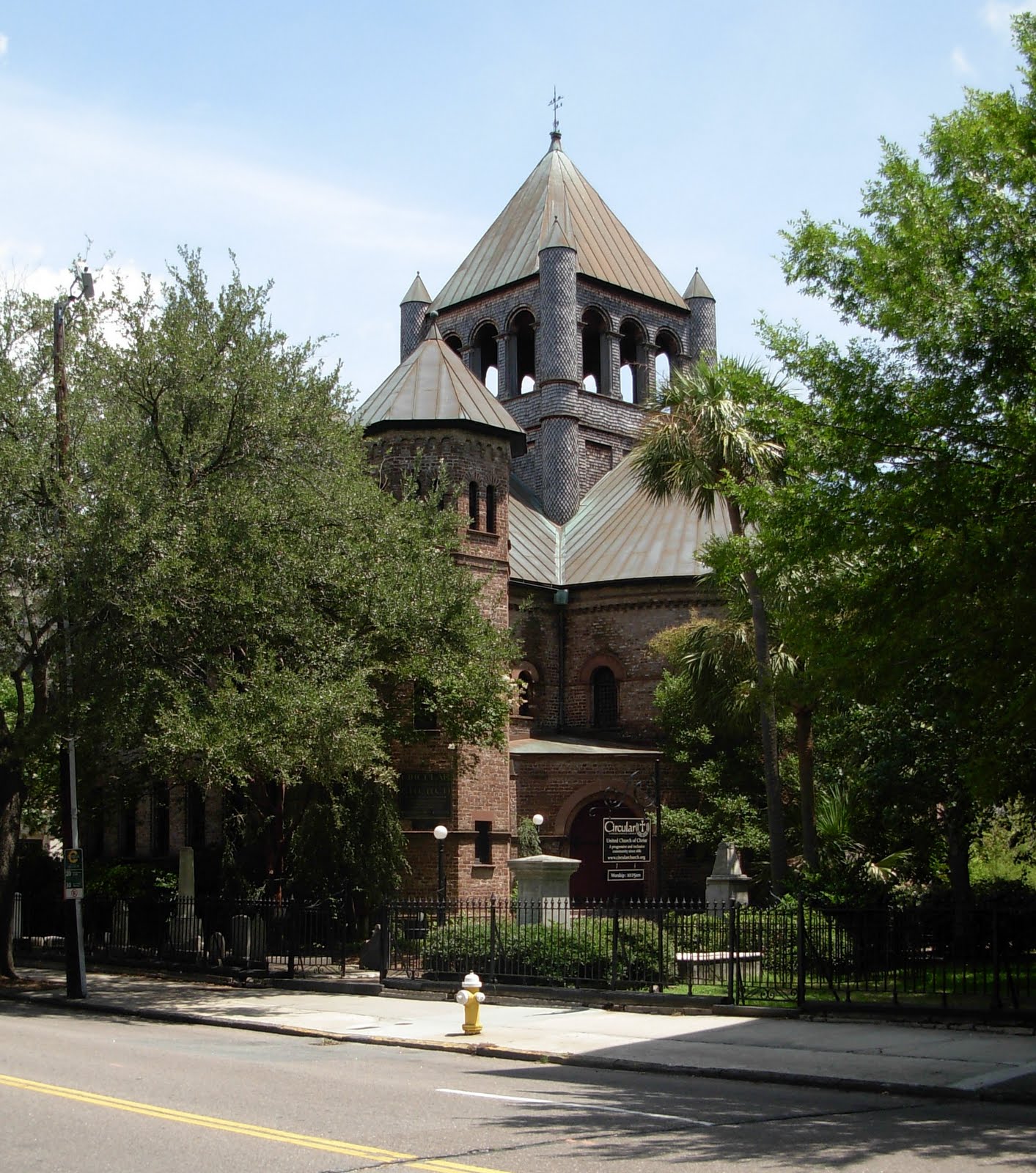 |
| Circular Congregational Church. Photo 2011, by Lewis Powell IV, all rights reserved. |
Of the stones commonly used for tombstones, slate is certainly one of the more durable. Marble, over time, melts away leaving stones with unreadable inscriptions, but it is easily carved. Granite, on the other hand, will last for centuries but it is not easily carved. Between these two is slate, which will not melt away over centuries and is more easily carved, though it is prone to chipping, cracking and breakage. Upon entering the front gate of the cemetery, there is a large slate stone that has been severely damaged.
 |
| The severely damaged stone at the entrance. Photo 2011, by Lewis Powell IV, all rights reserved. |
 |
| A grouping of slate stones. The stone on the right with the wood support is described in one book as the oldest slate marker in the US. Photo 2011, by Lewis Powell IV, all rights reserved. |
 |
| Another grouping of headstones. Note how closely placed these are. Photo 2011, by Lewis Powell IV, all rights reserved. |
The marvelous thing about slate is that it is so durable in that stones carved centuries ago often are very clearly readable and in some cases appear almost brand new, especially when compared to their younger marble counterparts that are fading and sometimes barely legible. The carving on these colonial slate stones is really magnificent and the church website has wonderful information on the evolution of slate tombstones in the late 17th and into the 18th centuries. The earliest slates bearing art use a skull and crossbones motif. Into the 18th century to this motif wings were added creating a "death's head."
 |
| A death's head motif. Being a bad taphophile who was hot and tired, I didn't write down the names and dates from these stones. Forgive me. Photo 2011, by Lewis Powell IV, all rights reserved. |
Towards the mid-18th century, these death's heads were replaced with portraits of the deceased. According to the church's website, these portrait stones are not found anywhere else in South Carolina or Georgia. I would make the assumption that these stones are meant as a sign of wealth and Charleston was considered the wealthiest city in the colonies.
 |
| The stone of Mrs. Elizabeth Simmons who died 18 September 1740. Photo 2011, by Lewis Powell IV, all rights reserved. |
 |
| Closeup of the Roman-style bust of Mrs. Simmons. Photo 2011, by Lewis Powell IV, all rights reserved. |
 |
| The very clear inscription. Photo 2011, by Lewis Powell IV, all rights reserved. |
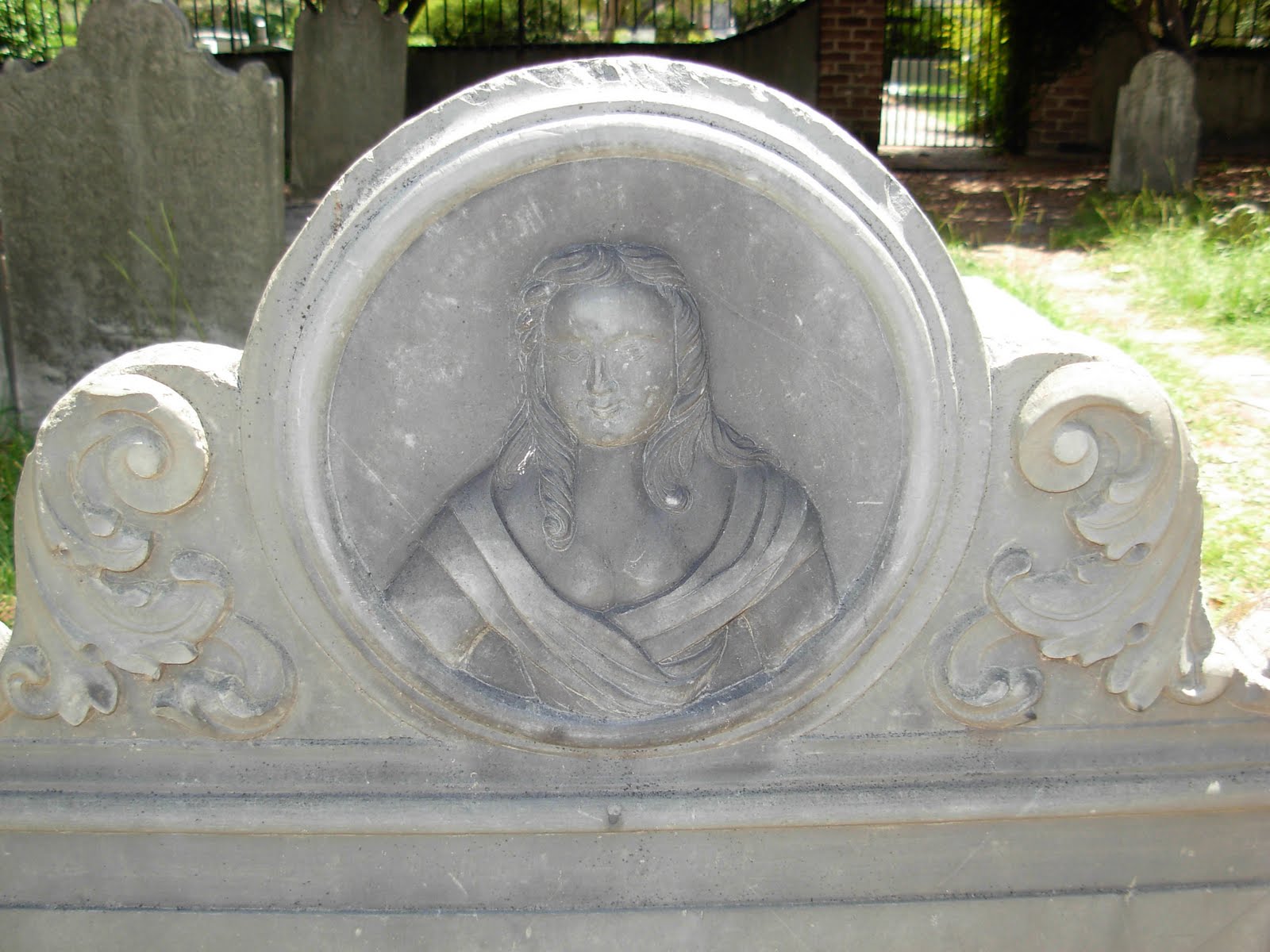 |
| Another portrait. Photo 2011, by Lewis Powell IV, all rights reserved. |
 |
| A man's portrait. Photo 2011, by Lewis Powell IV, all rights reserved. |
 |
| A fairly elaborate man's portrait. Photo 2011, by Lewis Powell IV, all rights reserved. |
 |
| A closeup, note the weeping putti framing the portrait. Photo 2011, by Lewis Powell IV, all rights reserved. |
 |
| This portrait, on the grave of Mr. Solomon Milner, who died in 1757, is described on the church's website as "the most notable and best preserved example of neoclassicism from 18th century Charleston." Photo 2011, by Lewis Powell IV, all rights reserved. |
The church notes that a number of tombstones have been lost. During the ghost tour that I took from Bulldog Tours, the guide mentioned that part of the church's cemetery is now under the paved bank parking lot next door.
 |
| Looking towards the parking lot next door, the cars in this photo may be parked on graves. Photo 2011, by Lewis Powell IV, all rights reserved. |
Bulldog Tours. Ghost & Dungeon Tour. 26 July 2011.
"Graveyard." Circular Congregational Church website. Accessed 31 July 2011.
Roffe, Denise. Ghosts and Legends of Charleston, South Carolina. Atglen, PA:
Schiffer, 2010.
Subscribe to:
Posts (Atom)